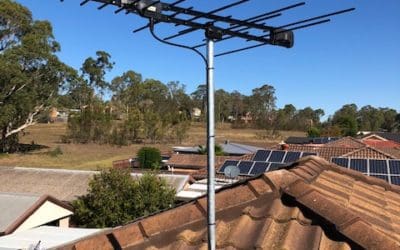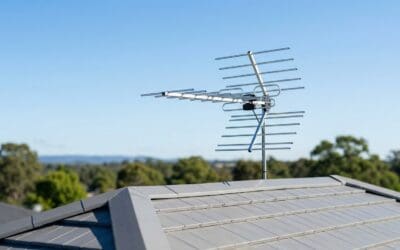
There is a pattern we see over and over again across Macarthur and Wollondilly. A homeowner buys a cheap antenna online, gets someone to put it on the roof, and it works fine for six to twelve months. Then the picture starts breaking up. Channels disappear. The elements corrode, bend, or snap off entirely.
By the time they call us, the cheap antenna has already caused more frustration (and often more expense) than buying a quality one from the start would have cost.
This is not a sales pitch for expensive gear. It is a reality check based on what we see on rooftops every week after more than 25 years in the business.
The Real Cost of a Cheap Antenna
You can buy a no-name antenna from an online marketplace for as little as $30 to $50. That sounds like a bargain compared to a professional installation with a quality antenna. But the price difference disappears quickly when you factor in what happens next.
Corrosion Starts Within a Year
Most cheap antennas are made with pressed steel, thin aluminium, or a mix of metals that react with each other in wet conditions. Western Sydney’s climate, with hot summers, humid nights, and occasional hailstorms, accelerates this corrosion. Within 12 to 18 months, you can see rust forming on the elements and the mounting brackets.
Once corrosion sets in, signal quality drops. The corroded metal changes the electrical properties of the antenna, which means it no longer picks up signal the way it was designed to. Corroded joins also create resistance in the signal path, weakening reception even further.
No 4G or 5G Filtering
Cheap antennas almost never include built-in LTE filters. With 4G and 5G towers now scattered across Macarthur (including new towers near Gregory Hills, Oran Park, and Leppington), unfiltered antennas pick up mobile interference that causes pixelation and dropouts.
Adding an external LTE filter after the fact costs extra money and adds another connection point that can fail. A quality antenna with a built-in filter solves this from day one.
Weak Mounting Hardware
The brackets and mast clamps that come with budget antennas are often undersized and made from soft metal. In a strong wind, they bend. The antenna shifts off alignment, and your signal drops. In a proper storm, the whole unit can come loose.
We have pulled damaged cheap antennas off roofs that have cracked tiles, scratched Colorbond roofing, and left rust stains running down the fascia. The repair bill for roof damage alone can cost more than a quality installation.
No Real Warranty
Most cheap antennas come with either no warranty or a vague “12 month warranty” that requires you to ship the product back to an overseas manufacturer. Good luck with that when it is bolted to your roof.
Compare that to the Hills range, which carries a genuine 5 year manufacturing warranty backed by an Australian company. If something goes wrong with the product (not the installation, but the actual antenna hardware), it gets dealt with locally.
What Makes a Quality Antenna Different
The difference between a $40 antenna and a professional-grade Hills antenna is not just the price tag. It is the engineering behind it.
Welded Aluminium Construction
Hills antennas use welded aluminium elements and booms. Aluminium does not rust. The welded construction means there are no screws, clips, or pressed joints that can loosen over time. The elements stay locked in position, which keeps the antenna tuned correctly for years.
Tuned for Australian Transmitters
Cheap antennas are usually generic, broadband designs made for overseas markets. They try to cover every possible frequency, which means they do not perform particularly well on any of them.
A Hills antenna is designed specifically for Australian broadcast frequencies. The UMX 36, for example, is tuned for the UHF band that carries digital TV from transmitters like Razorback. The Black Arrow is tuned for VHF signals from Artarmon. This focused design delivers a much stronger, cleaner signal in [suburbs across Macarthur https://www.macarthurantennas.com.au/areas-of-service/].
Built-in 4G Filtering
As mentioned above, modern Hills antennas include integrated 4G filtering. This is built into the balun (the component that converts the signal from the antenna into a form the cable can carry). No external filter box is needed.
Designed for Australian Weather
Australia’s UV exposure, temperature swings, wind loads, and occasional hail events are tough on outdoor hardware. Hills antennas are tested for these conditions. The materials, coatings, and connection methods are all chosen to last in the Australian climate.
What We See on Rooftops Every Week
Here are a few real patterns from the jobs we do across Macarthur.
New build estates. Many builders install the cheapest antenna they can find to tick the “TV antenna installed” box at handover. Homeowners move in, and the reception seems fine for a while. Within a year or two, the signal degrades as the cheap hardware corrodes and nearby 4G towers come online. We replace these regularly in suburbs like Spring Farm, Oran Park, and Gregory Hills.
DIY installations. Homeowners who install their own antenna often choose a cheap unit and mount it lower than ideal (because getting higher on the roof feels risky, and rightly so). A lower mounting position combined with a lower-quality antenna means a marginal signal from the start. Any change in conditions, such as wind, rain, or a new house built next door, tips the signal below the dropout threshold.
Handyman specials. A general handyman can physically bolt an antenna to a roof. But without signal testing equipment and knowledge of which transmitter your suburb uses, there is no way to confirm the antenna is the right type, pointed in the right direction, and delivering an adequate signal level. We often find antennas pointed the wrong way entirely.
The Numbers That Matter
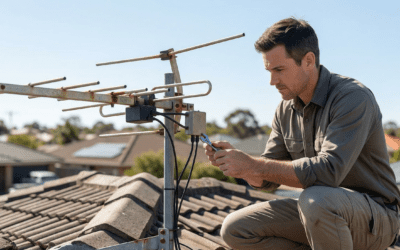
When we do a [professional antenna installation https://www.macarthurantennas.com.au/tv-antenna-installation/], we test signal levels with electronic equipment at your home. We measure the signal strength in dBuV (decibels microvolts) at the antenna, at the cable entry point, and at each TV point inside the house.
For reliable digital TV reception, you need a minimum signal level around 45 to 50 dBuV at each TV point. A quality antenna on the right mast height, pointed at the correct transmitter, typically delivers 60 to 75 dBuV. That margin above the minimum is what keeps your picture stable in bad weather, when interference spikes, or when someone adds an extra TV point.
A cheap antenna on a short mast, with corroded connections and no LTE filter, often delivers 48 to 52 dBuV. That is technically above the threshold, but there is almost no margin. Any small change pushes the signal below the dropout point.
What We Recommend
We install Hills antennas exclusively because they consistently deliver the best results in our region. We have tested other brands over the years and always come back to Hills for three reasons: they hold up in Australian weather, they deliver strong signal in Macarthur’s terrain, and the warranty is real.
For most suburbs south of Campbelltown (Camden, Narellan, Harrington Park, Mount Annan, Cobbitty, Currans Hill, Spring Farm, Oran Park, Leppington, Tahmoor, Picton, and surrounds), the Hills UMX 36 UHF antenna pointed toward Razorback is the standard recommendation.
For suburbs that receive from Artarmon (Campbelltown, Ingleburn, Leumeah, and areas closer to Glenfield), the Hills Black Arrow VHF antenna is the go-to choice.
In some suburbs, you need both UHF and VHF, and we set that up with a combiner so everything runs through a single cable.
Stop Paying Twice
The most expensive antenna is the one you have to replace after a year. A quality installation with the right hardware, proper alignment, and tested signal levels costs more upfront. But it lasts longer, performs better, and comes with a real warranty.
If you are dealing with [reception problems from a cheap or aging antenna https://www.macarthurantennas.com.au/antenna-repair/], or if you want it done right the first time on a new build, [get in touch with Jamie at Macarthur Antennas https://www.macarthurantennas.com.au/contact-us/]. Free quotes, honest advice, and Australian-made hardware that is built to last.