When you are building a new home or renovating an older one, TV points are one of those things that are easy to get wrong. Install too few and you are stuck running cables across the floor or relying entirely on Wi-Fi streaming. Install too many and you have paid for outlets you will never use.
The right number depends on how your household actually watches TV, where your screens are, and how you plan to use each room. Here is a practical breakdown for a typical 4 bedroom home in the Macarthur and Wollondilly region.
What Is a TV Point?
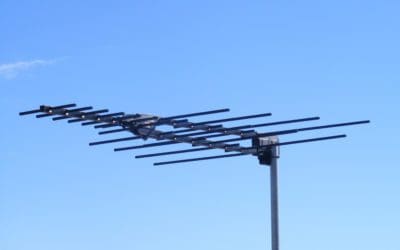
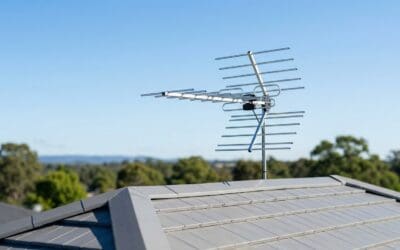
A TV point (sometimes called an antenna point or TV outlet) is a wall-mounted socket that connects to your rooftop antenna via coaxial cable. You plug your TV into it, and it receives free-to-air digital channels.
Each TV point runs on a separate cable from a central splitter or distribution board, usually located in the roof cavity. The splitter divides the signal from the antenna into multiple paths, one for each TV point.
The quality of your signal at each point depends on three things: the strength of the signal at the antenna, the number of points the signal is split across, and the quality of the cables and connections.
The Short Answer: 3 to 5 Points
For most 4 bedroom homes in our area, 3 to 5 TV points covers the practical needs of the household. Here is how that typically breaks down.
Living Room (1 point, almost always)
This is the primary viewing area and the one TV point nobody skips. The living room or family room TV is usually the largest screen in the house and the most used. If you are also running a soundbar or AV system from this location, the TV point feeds the tuner while HDMI handles the audio connection.
Master Bedroom (1 point, recommended)
Most households have a TV in the master bedroom. A dedicated TV point here means you do not rely on streaming or Wi-Fi for free-to-air channels. It also keeps things simple. Plug in, tune, done.
Second Living Area or Rumpus Room (1 point, recommended)
Many 4 bedroom homes in the Macarthur region have a second living space, often called a rumpus room, media room, or retreat. If this room has a screen (or is likely to get one in the future), a TV point is worth installing during construction when the cables are easy to run.
Kitchen (optional, 1 point)
Some households like having a small TV in the kitchen. If this is your setup, a TV point makes sense. If you only use a tablet or phone in the kitchen, skip it.
Kids’ Bedrooms (optional, 0 to 2 points)
This is where the decision gets personal. Some families put TVs in the kids’ rooms. Others do not. If you are building a new home, it costs very little to run the cable during construction even if you do not install the wall plate right away. Having the cable in the wall gives you the option later without needing to retrofit.
Outdoor Area or Alfresco (optional, 1 point)
If you have a covered alfresco or patio area and plan to mount a weatherproof TV there, a TV point makes watching sport outside a lot more practical than trying to stream on a tablet in direct sunlight.
Why More Points Means a Weaker Signal (Unless You Plan for It)
Every time the antenna signal is split to feed another TV point, each point receives a smaller share of the total signal. A 2-way split cuts the signal roughly in half. A 4-way split divides it into quarters.
If your antenna is delivering a strong signal (say, 65 to 75 dBuV at the antenna), splitting it four ways still leaves enough signal at each point to produce a clear, stable picture. But if the antenna signal is marginal to begin with (50 to 55 dBuV), splitting it four ways can push each point below the minimum threshold for reliable digital TV.
This is why the antenna and the TV points need to be considered together, not separately. A quality [antenna installation https://www.macarthurantennas.com.au/tv-antenna-installation/] that delivers a strong signal at the source makes it possible to run 4, 5, or even 6 points without problems. A weak antenna with 5 points connected will give you trouble on every screen.
When You Need a Distribution Amplifier
If your home needs more than 3 or 4 TV points, or if the signal at the antenna is moderate rather than strong, a distribution amplifier (also called a masthead amplifier) can boost the signal before it is split.
The amplifier sits at the antenna, powered by a small supply unit inside the house. It increases the signal level so that after splitting, each TV point still receives enough to produce a clean picture.
We install amplifiers as part of the antenna system when the situation calls for it. They are common in larger homes, homes further from the transmitter, and homes in areas with marginal signal like parts of [Bargo https://www.macarthurantennas.com.au/bargo/], [Appin https://www.macarthurantennas.com.au/appin/], and [Wilton https://www.macarthurantennas.com.au/wilton/].
New Builds vs Existing Homes
The best time to install TV points is during construction, before the plasterboard goes up. Running cables through open wall frames and ceiling cavities is quick, clean, and cheap. Adding TV points to a finished home is still possible, but it costs more and may require visible cable runs or access through the roof cavity.
New Builds
If your home is being built in one of the new estates across [Oran Park https://www.macarthurantennas.com.au/oran-park/], [Gregory Hills https://www.macarthurantennas.com.au/gregory-hills/], or [Spring Farm https://www.macarthurantennas.com.au/spring-farm/], talk to your builder about running cables for TV points during the rough-in stage (when the electrician is doing the wiring). Even if you only want 3 active points now, having cables pre-run to 5 locations gives you flexibility later.
Some builders offer a TV and data cabling package as an upgrade. Compare what they offer with what a [dedicated antenna and cabling specialist https://www.macarthurantennas.com.au/tv-point-installation/] would charge. In many cases, a specialist provides better hardware, proper signal testing, and a warranty that the builder’s sub-contractor does not match.
Existing Homes
In an older home, adding TV points usually means running cable through the roof cavity and down through the wall to a new wall plate. The difficulty depends on the layout of your home, the accessibility of the roof cavity, and whether the walls are plasterboard (easier) or brick (harder).
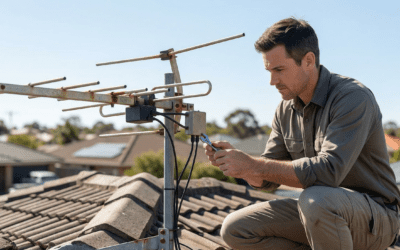
A single additional TV point in an existing home is a straightforward job for an experienced installer. We also check the existing antenna system when adding points to make sure the signal is strong enough to support the extra load.
What About Streaming? Do You Still Need TV Points?
Streaming services like Netflix, Stan, and Disney+ do not use TV points. They run through your internet connection, either via Wi-Fi or an ethernet cable. So if your household watches almost entirely through streaming apps, you might not need as many TV points.
But free-to-air TV still has value. Live sport, local news, and major events are free and do not count toward your internet data. And unlike streaming, free-to-air TV does not buffer, lag, or depend on your internet speed. If your NBN drops out or your [Starlink connection https://www.macarthurantennas.com.au/starlink/] has a temporary obstruction, your free-to-air channels keep working because they come from the antenna, not the internet.
For most households, a combination of a few well-placed TV points for free-to-air and a solid internet connection for streaming is the most practical setup.
The Cost of Getting It Wrong
Installing too few points during construction and retrofitting later costs more than getting it right from the start. Running a cable through a finished wall and ceiling is more labour-intensive than doing it during the build, and it often leaves visible cable runs or requires patching plasterboard.
On the other hand, installing a TV point that never gets used is a minor cost compared to the hassle of adding one later. If you are unsure about a particular room, our recommendation is to run the cable during construction and leave it capped in the wall. You can add the wall plate and connect it any time in the future.
Get the Right Setup for Your Home
Every home is different. The number of TV points you need depends on your screen locations, your signal strength, and how your family watches TV. We can advise on the right number of points, the best locations, and whether your antenna system can support them without an amplifier.
[Contact Jamie at Macarthur Antennas https://www.macarthurantennas.com.au/contact-us/] for a free quote on TV point installations, new antenna setups, or a combination of both. We service every suburb from Glenfield to Bargo