If your home was built before 2013, there is a good chance the antenna on your roof was designed for analog TV signals. Australia switched off analog broadcasting years ago, but thousands of homes across Macarthur and Wollondilly still have the old hardware sitting up there, working harder than it needs to.
You might still be getting a picture. That does not mean your antenna is doing a good job. Here is what the difference actually means for your reception, and why it matters more than most people think.
What Changed When Australia Went Digital
When Australia completed the digital switchover, every free-to-air broadcaster moved from analog signals to digital signals. The content is the same. The channels are the same. But the way the signal travels from the transmitter to your home changed completely.
Analog signals degrade gradually. When the signal weakens, you see a snowy, fuzzy picture. It gets worse slowly, and you can still make out what is on screen even with a weak signal.
Digital signals work differently. They are either strong enough to produce a perfect picture, or they drop below the threshold and you get nothing. No gradual fade. Just pixelation, freezing, and then a blank screen. This all-or-nothing behaviour is why a digital antenna needs to deliver a cleaner, stronger signal than the old analog ones did.
Are Analog Antennas and Digital Antennas Actually Different?
This is where it gets a bit misunderstood. There is no magic “digital” component inside a modern antenna. Both analog and digital antennas receive radio waves in the same frequency bands. The difference is in the design, the build quality, and how well the antenna is tuned for the frequency range your local transmitter uses.
Modern antennas (often marketed as “digital ready”) are typically built with tighter specifications. They have better gain patterns, improved front-to-back ratios (so they reject interference from behind), and built-in 4G/5G filtering. These design improvements matter a lot more in the digital era because of that all-or-nothing signal behaviour.
An old analog antenna can still receive digital signals. But it often does so with a weaker, noisier signal that sits right at the dropout threshold. On a calm day, you might be fine. On a windy afternoon when the antenna moves slightly, you lose the picture.
Why Old Antennas Struggle in Macarthur
The Macarthur region receives signals from two main transmitters. Suburbs around Camden, Narellan, Harrington Park, and Cobbitty point toward the Razorback transmitter on Mount Hercules Drive. Suburbs closer to Campbelltown, Ingleburn, and Leumeah typically receive from the Artarmon transmitter in Sydney’s north.
Old analog antennas were often broadband designs that tried to pick up a wide range of frequencies. Modern [digital antenna installations https://www.macarthurantennas.com.au/tv-antenna-installation/] are tuned more tightly to the specific frequency band your transmitter uses (UHF or VHF), which gives you a stronger signal with less noise.
In areas like Gregory Hills, Oran Park, and Spring Farm, where new housing estates have grown rapidly, the old antenna infrastructure that worked 15 or 20 years ago is now surrounded by two-storey homes, metal roofing, and new mobile towers. A modern antenna designed for these conditions performs significantly better than one installed in 2005.
The 4G and 5G Interference Problem
This is one of the biggest reasons old antennas cause trouble in 2026. When analog antennas were installed, there were no 4G or 5G mobile towers transmitting on frequencies close to the TV band. Now there are.
Mobile signals can overload an old antenna’s amplifier or bleed into the TV frequency range, causing pixelation, ghosting, or complete signal loss. Modern antennas include a built-in 4G/5G filter (sometimes called an LTE filter) that blocks these interfering frequencies before they reach your TV.
If you live near a mobile tower and your old antenna does not have this filter, you may notice that your reception has gotten worse over the last few years even though nothing changed on your roof. The problem is not your antenna aging. It is the environment around it changing.
Signs You Still Have an Analog-Era Antenna
You do not need to climb on your roof to check. Here are some clues.
Your home was built before 2010 and the antenna has never been replaced. If the house came with an antenna pre-installed and nobody has touched it since, it is almost certainly an analog-era design.
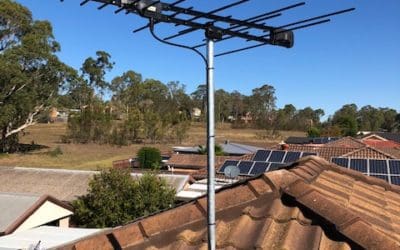
The antenna looks large and wide with many horizontal rods. Older VHF antennas, in particular, tend to be physically larger than modern UHF models. If the antenna on your roof looks like it belongs on a 1990s house, it probably does.
You can see rust, corrosion, or bent elements. Older antennas were often made with steel or lower-grade aluminium that corrodes faster than the welded aluminium used in modern Australian-made antennas.
Your reception drops out on windy days or when it rains. This is a classic sign of a marginal signal, which is exactly what happens when an old analog antenna tries to deliver a digital signal right at the dropout threshold.
What a Modern Antenna Looks Like
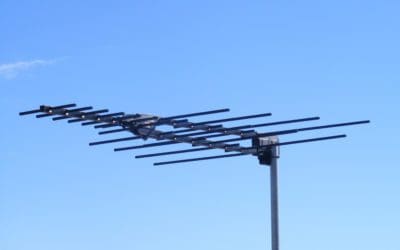
The antennas we install across Macarthur are Hills brand, Australian made, with welded aluminium construction. They are compact, lightweight, and built to handle local weather conditions including the high winds and storms that roll through the region.
For suburbs pointing toward Razorback (Camden, Narellan, Harrington Park, Mount Annan, Cobbitty, Spring Farm, Oran Park, and surrounds), we typically install the Hills UMX 36, a compact UHF antenna with strong signal pickup and built-in 4G filtering.
For suburbs that need the Artarmon signal (Campbelltown, Ingleburn, Leumeah, and areas north), the Hills Black Arrow VHF antenna is the standard choice. It is a high-gain design that locks onto the VHF frequency range with minimal interference.
Both come with a 5 year manufacturing warranty and are rated for Australian conditions. That means no corrosion, no bird damage to the elements, and a stable signal for years.
Should You Upgrade?
If your antenna is working perfectly, delivering strong signal on every channel with no dropouts, there may not be an urgent reason to change it. But if you are experiencing any of the issues above, or if your antenna is more than 15 years old, an upgrade is worth considering.
A modern antenna matched to your suburb’s transmitter will give you a stronger, more reliable signal. It will handle 4G and 5G interference without an external filter. And it will last longer because it is built with better materials.
The cost of a new [antenna installation https://www.macarthurantennas.com.au/tv-antenna-installation/] is often less than people expect, especially when you compare it to the hassle of ongoing [reception problems and repeat repairs https://www.macarthurantennas.com.au/antenna-repair/].
Get the Right Antenna for Your Suburb
Every suburb in the Macarthur and Wollondilly region has different signal conditions. The antenna that works perfectly in Camden might not be the right choice for Campbelltown. That is why we test signal levels at your home before recommending anything.
[Contact Jamie at Macarthur Antennas https://www.macarthurantennas.com.au/contact-us/] for a free quote and signal test. We will tell you exactly what your home needs based on real data, and we only install Australian-made hardware backed by a genuine warranty.